

Shifting Tides
How Short-Stay Flexibility is Reshaping the OBX Rental Market
By Ann Wood
For generations, summer on the Outer Banks followed a steady rhythm: Saturday-to-Saturday family traditions, returning to the same homes year after year. But that rhythm is changing. Since the rise of Airbnb and a post-pandemic surge in domestic travel, more visitors are choosing three- or four-night getaways, often booked at the last minute. For property managers and homeowners accustomed to calendars full of 7-night stays, this shift brings both opportunity and uncertainty.

A New Kind of Vacationer
Americans are increasingly spreading their vacation time across several shorter trips. Deloitte’s 2025 Summer Travel Survey found that travelers now plan an average of 3.1 summer trips, up from 2.3 the year before, and 41% expect their longest trip to be three nights or fewer. Remote and hybrid work arrangements are also encouraging this flexibility: 23% of travelers expect to work during their trip, making quick escapes more feasible. Granted, the Outer Banks is a traditional week long family vacation destination and slower to adopt change, but the tide is turning.
“Short stays have absolutely grown in visibility over the last two to three years,” said Carrie Bateman, Director of Property Management at Beach Realty & Construction. “We’re seeing more guests booking long weekends, midweek dips, and ‘testing the waters’ stays before committing to a full week.”
Bateman continues, “Guests want flexibility, and they’re planning more spontaneously than they used to—sometimes even just a few days before arrival.”
While weekly rentals still dominate summer, demand for shorter stays is rising even during prime months, especially among smaller groups, couples, and remote workers. “It’s not a tidal wave yet,” Bateman said, “but the current is moving in that direction.”
Tracking the Trend
The shift extends beyond the Outer Banks. Key Data Dashboard’s 2025 Vacation Rental Industry Outlook, a survey of 203 property-management professionals representing more than 52,000 properties, found that the industry is paying close attention to shorter stays as a strategic lever for the year ahead. This reflects a broader shift in how travelers plan and book their trips.
Local analytics echo the trend. According to data reported to the Outer Banks Visitors Bureau by Datafy, the average length of stay on the Outer Banks decreased by 0.7 days from 2023 to 2024, and by another 0.2 days in 2025. And Airbnb search data shows similar momentum with 67% of searches for stays under seven nights, and nearly half for stays under five. These figures underscore just how strong the traveler demand is for short-stay flexibility in the area.
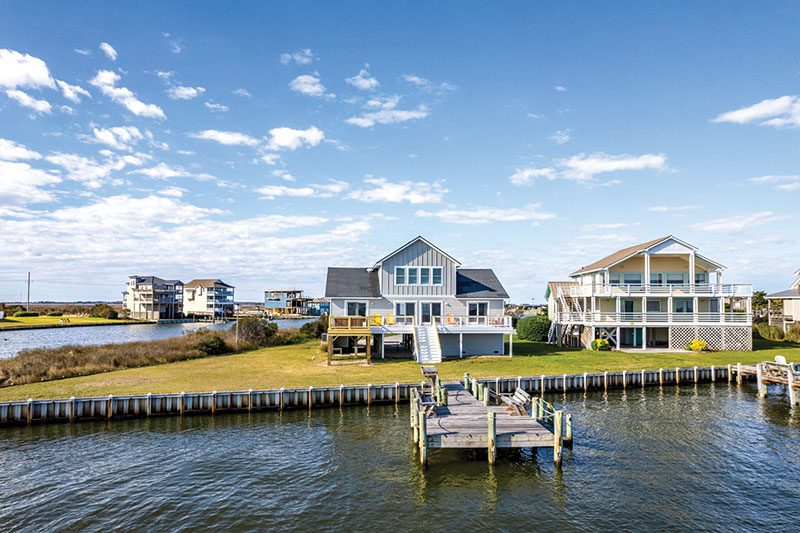
Photo courtesy of Coastal Carolina Vacations.
Visitor Behavior and Local Impact
Short-stay guests behave differently from traditional week-long vacationers, and that matters for local businesses.
“The short-stay vacationer is typically more spontaneous and experience-driven,” Bateman explains. “They travel lighter and are looking for a quick, recharging getaway. Week-long guests come for rituals; short-stay travelers come for flexibility and quick adventure.”
Short-stay travelers tend to dine out more, seek more activities, and try to fit as much into their limited time as possible. Restaurants and recreation providers stand to benefit. And two shorter bookings within a week can bring more people to the area, creating more overall economic activity than a single 7-night stay.
The Homeowner Perspective
If traveler demand is shifting, homeowners must adjust accordingly. Many long-time owners are accustomed to tidy 7-night stays and longer booking windows. Opening calendars to shorter stays can introduce more complicated pricing, occasional nights left unbooked, and last minute bookings.
Yet the reality, Bateman noted, is often counterintuitive. Short-stay guests typically travel in smaller groups and spend less time in the home, which can reduce wear and tear.
To help owners understand the revenue potential, managers increasingly rely on analytics – average daily rates, booking windows, occupancy rates, and total net revenue. Homes that allow short stays, particularly in spring and fall, often achieve stronger annual performance than those limited to strict 7-night minimums. Still, the strategy must be tailored: location, home size, amenities, and owner goals determine whether flexibility pays off.
“Short stays, when managed intentionally, can significantly improve occupancy in early spring, late fall, and winter,” Bateman said. “A blended approach, retaining weekly stays during peak season while offering flexibility outside those windows, can boost revenue without disrupting the traditional summer model.”
Balancing Flexibility and Tradition
The growing trend of short stays can be easier logistically for individual Airbnb hosts managing only a few properties. For large professional managers managing hundreds of homes with a variety of locations, amenities, and bedroom counts, the logistics are far more complex—especially around labor and scheduling.
Many people who clean vacation homes on the Outer Banks are balancing a full time job with cleaning on the weekends. Others, while they might be available and willing to work more days of the week, need to have enough work to make it worth driving the sometimes 3-hour round trip to clean.
Carolina Designs Realty has maintained a strong focus on full-week rentals as the cornerstone of its business, while selectively offering partial-week stays during shoulder seasons. Pierce Holian, Director of Revenue & Rental Management, explains their hybrid model. “A shorter stay model can be useful during shoulder weeks, as long as the daily rate is competitive and mutually beneficial for the guest and homeowner.” Holian adds, “Operationally, the biggest consideration is the turn-clean, which is the same for a 3-day stay as for a 7-day stay. Scheduling can be more complex, but it’s manageable.”
Holian notes that with an inventory ranging from 4 to 30 bedrooms, flexibility must be strategic. “Every house is different, so we operate with a hybrid model of full-week stays supplemented with partial-week stays to make sure we’re doing the best job we can for our homeowners.”
Looking Ahead
As traveler habits evolve, the Outer Banks is adapting to a more diverse vacation landscape. Weeklong family vacations remain the backbone of summer, but shorter, flexible stays are attracting new visitors, and shaping how families experience the area.
“The ability to book shorter stays allows visitors to better manage their travel budget and their available vacation time,” said Lee Nettles, managing director of the Outer Banks Visitors Bureau. “People like having options.”

Author: Ann Wood


