

Soaring to New Heights
Student-Built Plane Readies to Take Flight
Written by Maya Gargol and Piper Truett
Their mornings begin with a walk across the street from First Flight High School to the maintenance buildings at the Wright Brothers’ National Memorial. Their average day in the “classroom” includes the clanging of tools, tightening rivets, running wires, getting on the ground, carefully applying fiberglass.

Boring, everyday lessons are nowhere to be found for the Aviation class at FFHS. These students are set to turn the sky into their personal runway by actually building a plane that will take its first flight in early 2026.
The project, led by Aviation teacher JT Tynch, a retired Navy Rear Admiral, got started about three years ago after then-Assistant Superintendent Steve Blackstock saw something on TV about a high school … somewhere … building a plane. He mentioned it to Dr. Shannon Castillo, who is Dare County Schools’ Director of Career and Technical Education, and First Flight was the obvious host for the ambitious project, much like Manteo High School students and their boat-building class.
“We’re right here in the shadow of the Wright Brothers National Memorial. It was a perfect fit,” Tynch says of the idea and follow-through. “Dr. Castillo goes on to find out what the program is and tracked down all the details. My daughter, Anna, then a junior at the school, told me about the program starting up and I got in touch with the school. Two and a half years later, here we are, and I’ve really enjoyed it.”
In this case, “here” is putting the finishing touches on the Tango Flight—provided classic RV-12iS Van’s Aircraft kit plane. The aircraft built by students over these three school years—including some summer and weekend work—is a side-by-side two-seater powered by a 100-horsepower engine with a maximum altitude of 14,000 feet. The plane holds 20 gallons of aviation fuel and burns four gallons an hour.
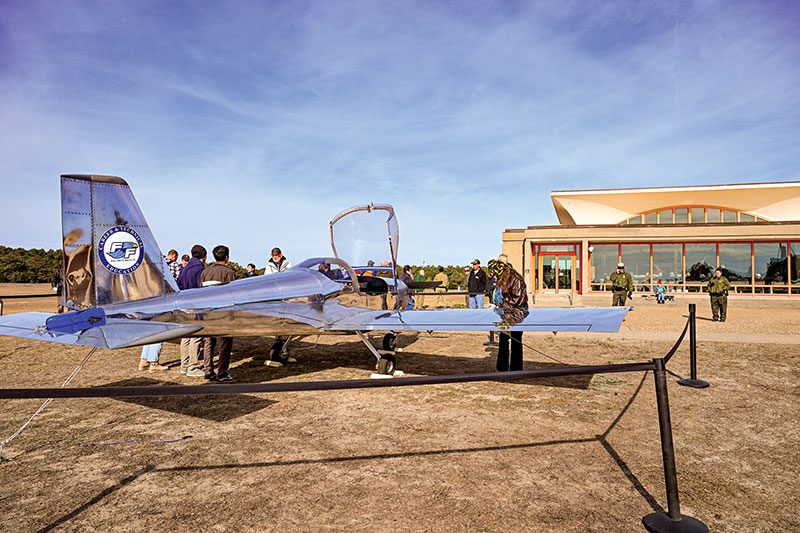
With the Wright Brothers National Memorial looming in the background, a crowd of about a thousand people gathered Dec. 17, 2025 to both celebrate the anniversary of the Wright Brothers’ first flight in 1903 as well as the completion of a plane built by First Flight High School students on the same spot 122 years later. The plane will be ready for its first test flight in early 2026. Photo by Wes Snyder.
The completed plane made its debut on Dec. 17 at the annual commemoration of Orville and Wilbur Wright’s first successful flight in 1903. While the plane didn’t take to the skies due to the unavailability of air worthiness inspectors necessary before the first flight, there was still plenty to celebrate.
“We really wanted to be done by the 17th of December,” Tynch says. “In the best-case scenario, we have a combined Wright Brothers anniversary of flight and commemoration of this aircraft, because this aircraft that these 15 are finishing up—and the classes before them have been a part of—is the first aircraft built on this location since the Wright Brothers.”
This school year, the Aviation class meets on Tuesdays and Thursdays from 8:30 to 11:25. After saying goodbye to 11 graduates in June, this class of six returning seniors, nine newcomers and six community mentors works together so everyone has their own important role in the project.
Tynch especially praised returning seniors Alex Sharp, Val Siegel, Finn Engley, Sam Sarbora, Jorge Flores Aguilar and Khalel Sibugan.
“Alex and Val have taken the burden of doing all the avionics work, Finn and Sam have done almost all the cowling work and engine install, and Jorge and Khalel have done a lot of everything else that’s required to get the aircraft ready,” Tynch says. “The nine newcomers have fallen right in, and you see them in the lab working on those same three big sections.”
This year included moving on from what Tynch called the “big muscle movements”—like putting together the cockpit, the tail and building the wings—to doing much more precise work.
“We have installed the engine, we’re doing all the avionics, the navigation equipment and the radios,” Tynch explains. “We’ve had to shape and build the cowling of the aircraft around the engine and do all the fiberglass work for the canopy itself.”
No matter the task, the students have to perform at a high level.
“I think the most challenging part is trying not to get frustrated,” Sarbora says, “because you have to do a lot of measuring, the same stuff over and over again, just trying to learn to do stuff better and faster.”
While all three years have seen a majority of boys in the Aviation classes, there is one girl this year who stands out. Siegel brings her own set of gifts and strengths to the workspace.
“There are some jobs I am uniquely fit for, because not only do I have smaller fingers than everybody else, which they have mentioned before, but I am just geared towards stuff that is smaller scale, naturally,” Siegel says. “I love working with my hands, and I love seeing something come together. Whenever you get something finished, especially with the electronics, it feels like you have done something.”
There are also a bunch of hands in this project that bring real-world experience to the workshop. This includes six community mentors who have given countless hours of their time to help the students take to the sky: Peter Fynn, Jim Davis, Tony Bruno, Tim Ribble, Scott Morton and Bob Newman.
Morton is a pilot, a flight instructor and has his own experience building a similar plane. He ran into someone one night who mentioned the project to him and decided it was something he could help with.
“It has been wonderful working with the kids. They’re a fine bunch of young men and women,” Morton says. “Everybody’s been engaged and interested. It’s a huge amount of effort required to get all this done, but we got closer every day.”
Newman has been involved with aviation as a pilot since about 1981 and also done some restoration and maintenance work, which also gives him many skills to bring to the table.
“I reached out to Tynch first, because I had a bunch of old ‘Sport Aviation’ magazines with great content in them,” Newman recalls. “So I just asked him, ‘You guys want these for your class?’ And he said, ‘Why don’t you come on up?’ That was the start of when I got here—and I couldn’t leave. Being able to share little tricks and techniques with the kids that you learn over time and being a team is what it’s about.”
From having a career Naval aviator at the helm to willing local volunteers and enthusiastic students at the controls to great partners with the National Park Service in providing the space and other support, it’s taken a team to get this project off the ground. The unveiling of the plane on Dec. 17 was a special moment for this long-awaited venture. When it soars into the sky for the first time in the coming months, higher and faster than the Wright Brothers could have imagined, history will be made once again.
“Without question, these kids will have a claim to fame that will stay with them forever,” Tynch says.
Maya Gargol and Piper Truett are juniors on the Shorelines Yearbook staff at First Flight High School.

Author: CoastalLife


