
Another Brick in the Wall
Historic Currituck Beach Lighthouse gets much-needed facelift
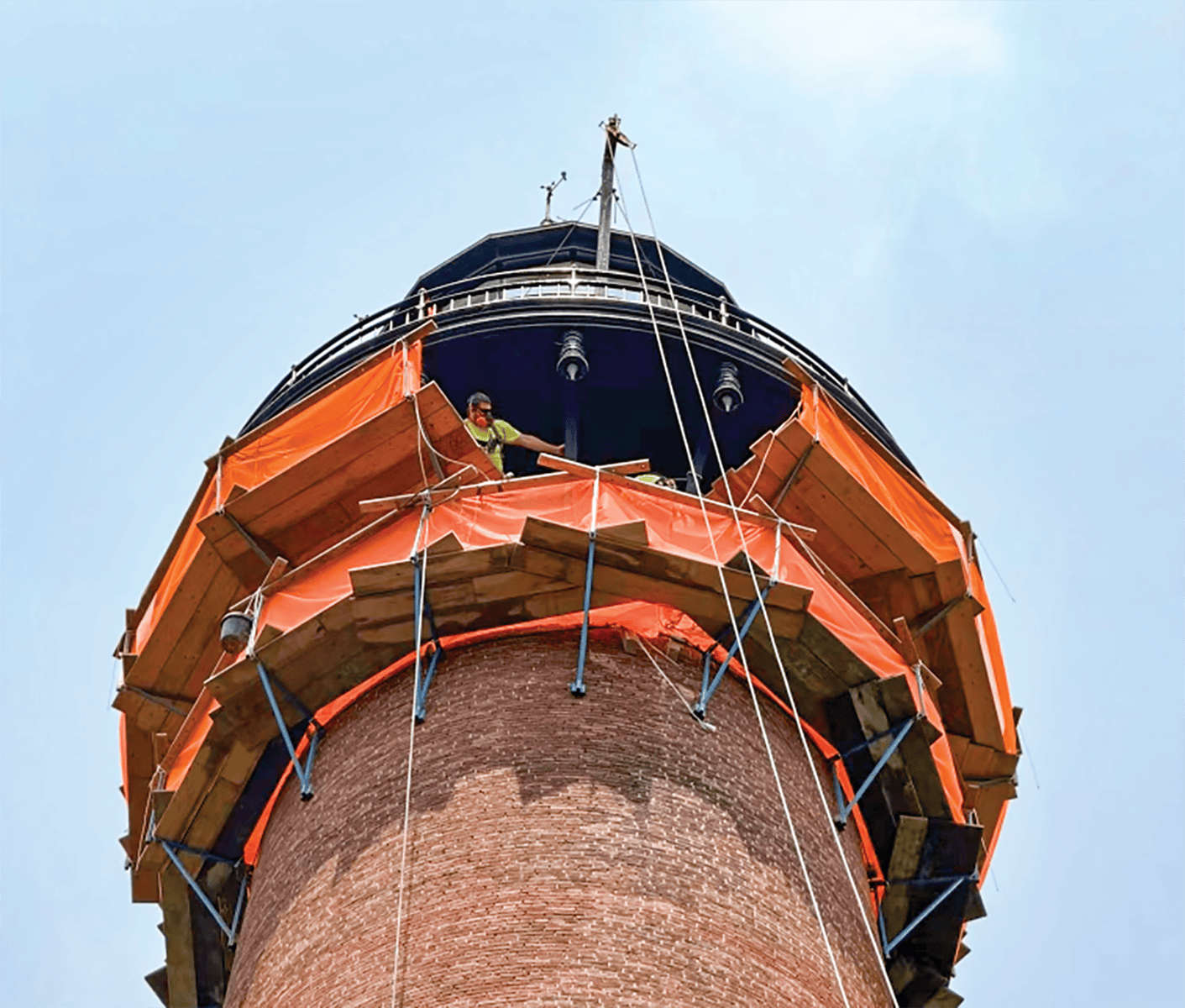
By Steve Hanf / The picturesque views of the famous lighthouse in Corolla included cables and work platforms as a team worked from July to October to repair the mortar from top to bottom. Image by Meghan Agresto.
One by one from 1873 to 1875, workers stacked some one million bricks to send the Currituck Beach Lighthouse soaring into the dark night.

More than 150 years later, the landmark still lights up the Corolla sky and puts bright smiles on the faces of the visitors who trek to the top for the breathtaking scenery.
The photos they’re snapping of this Outer Banks icon do, however, look a little different this summer and fall. That’s because, one by one, workers are repairing the brickwork of the entire 162-foot structure.
Now, it’s not ALL million bricks . . . but it’s no small feat, either.
“You gotta take into consideration the fact that the lighthouse is also very thick—we’re only doing the outside skin,” says Roy Fischer, foreman of the project for ICC-Commonwealth. “So, not a million, but if my calculations are correct, the linear footage of mortar joint is just over 23 miles. “It’s gonna take a little bit, but we’ve done things very similar to this,” he adds. “You get at least one big pointing job every year.”

As salt air, moisture and time combine to damage mortar between bricks, water leaks can spring up and eventually lead to chunks of damaged sections of the historic structure. The job of repointing the bricks strips away the outer layer of crumbling mortar so a new watertight seal can be installed. Top image courtesy of ICC-Commonwealth. Bottom Image by Meghan Agresto.
For those unfamiliar with brick structures, the process of repointing involves digging out the old, crumbling mortar from between bricks and replacing it with new mortar. Tight seals, of course, keep out water and protect the integrity of the structure.
Fischer has been with ICC for 14 years and worked on different parts of the Currituck Beach Lighthouse several times. He points a massive arm to a spot halfway up the tower to highlight an area where all the mortar had crumbled away in recent years. Water and salt air don’t play nice with building materials.
“The whole idea of repointing the exterior mortar joints is to make sure you’re not allowing any water incursion, because if water gets inside it filters down through: That’s why the cast-iron belt courses at the bottom are cracking,” Fischer says. “When I was here in 2020, I drilled a quarter-inch hole in the upper belt course and it leaked water for three days, just a steady stream.”
(Fischer’s burly physique, bushy beard and affable personality complete the picture of “brickmason” for your mind’s eye, by the way, as he shares detailed info about this most unique bit of tradecraft.)
The repointing process isn’t necessarily as complicated as it may seem. A grinder or more specialized power tool called an Arbortech brick and mortar saw cuts through the existing mortar joints, and specialized shrouds hooked up to HEPA filters catch the dust. After all the exterior layers of mortar are removed, then the new mortar is carefully mixed and applied.
Granted, it’s not exactly a day in the park for the team of five, either. They work from 6:30 a.m. to 3:30 p.m. six days a week to avoid the worst of the late-afternoon heat, but one August afternoon the exterior temperature of the bricks reached 130 degrees. Toss in the fact that they’re suspended high off the ground on work swings, tediously going brick by brick in swaths about four and a half feet wide, and it’s easy to see how challenging it actually can be.
“I always tell the guys, ‘Listen, if you gotta come down, come down—it’s not the end of the world. I don’t need to have to come up and rescue you,’ ” Fischer says of working in the heat, especially. “It can get very run-of-the-mill, tedious, but every one of these guys, it’s grab your grinder, headphones in, music’s on the phone, grinding mortar joints—all 23 miles of them.”

Site Superintendent Roy Fischer takes in the scenery from the top of the Currituck Beach Lighthouse. Fischer has worked on lighthouse restoration projects up and down both coasts for years and is no stranger to Corolla. Images by Meghan Agresto.
The work began July 8 and Fischer was pointing to an end date around Halloween. His goal was to be back home in Buffalo in time for his wife’s birthday and to enjoy some of the hunting season with his son before getting called to the next job.
It’s an interesting life for the crew. Some are married with kids, while some had girlfriends come enjoy a beach week vacation over the course of the job. When the workday ends, the guys enjoy the “when in Rome…” kinds of activities you’d expect. Fischer says a coworker on a past Corolla job loved surfcasting and got him into fishing on the four-wheel-drive beaches. Others have gotten into surfing.
“It’s a gorgeous place to work,” says Fischer, who at this point in his career works almost exclusively on lighthouse jobs and has done projects up and down both coasts in every state except California, Hawaii and Alaska. “It’s enjoyable. You get the camaraderie of the crew, live in the keepers’ quarters—the accommodations are better on this one than they are in some.”
Staying in the keepers’ quarters just steps away from their worksite can be a bit rustic, but also adds to the charm. They’ve seen Corolla’s wild horses munching on grass just off the porch in years past.
Then, of course, there’s also the matter of the ghost.
Fischer laughs when sharing that some locals have mentioned the keepers’ quarters being haunted.
“My buddy, when we were here before, he’s Cambodian and has his customs and superstitions,” Fischer says. “Anytime he would cook, he would leave a little bowl of everything we made on the back of the stove, just as a ‘please don’t kill me in my sleep’ type of thing.”
The alleged phantom hasn’t kept ICC teams away, but if all goes according to plan, they might not be back for a while. The goal of this top-to-bottom repair is to make it last, Fischer says, estimating that this full-scale mortar work could make it 20-plus years.
That would be just fine for site manager Meghan Agresto. Her busy summer has included fielding the endless question, “Is the lighthouse still open for climbing?”
The answer is always an enthusiastic “yes!” for this keeper of the light who arrived in Corolla in 2005 and has been a community fixture ever since. On this hot August day, she juggles her usual tasks of chatting with visitors, arranging the docents’ schedules, checking in with Fischer’s team, and offering an info-filled walk-and-talk interview up the 220 steps to the top of the tower.
The Outer Banks Conservationists group owns the Currituck Beach Lighthouse, and that $13 climbing fee paid by thousands of visitors each summer maintains the structure. Agresto says with a laugh that “every few years we have to put a million dollars into it,” but is proud that the funds are there to, quite literally, keep the lights on.
“The funny thing is, I don’t feel like it’s mine,” she says as she looks out over the historic site with the sound and sea stretching endlessly on either side. “I feel like it’s ours. I am proud of the business model that runs this place, and we have the privilege of having a big, tall, historic North Carolina-proud site, so that certainly does make it easier to be like, ‘Hey everybody, get involved, love your lighthouse.’ ”
Steve Hanf is the journalism teacher at First Flight High School and has enjoyed many a climb to the top of the Currituck Beach Lighthouse over the years.