

Taking a “Byte” Out of Crime in KDH
Cybercrime K9’s Remarkable Impact on Internet Safety
By Steve Hanf
Sailor is one cute dog. Jet black, downy-soft fur. Pink tongue lolling. Tail enthusiastically wagging. She lights up every room she enters.

Which is good. Because Sailor’s primary job involves dark, ugly stuff. The kinds of things people don’t like to talk about … but need to talk about.
So, what better way to get a conversation started than by petting an adorable 18-month-old Black Lab when you see her and Kill Devil Hills Police Detective Peden at a community event or in your school?
“Right now, it’s been more outreach education just because that is the only way we’re going to put a damper on some of these trends that are trending up, so that’s a big push,” Peden says.
The numbers Peden is talking about involve kids and online safety. He’s part of the North Carolina Internet Crimes Against Children Task Force (ICAC), which investigates cases surrounding online enticement, child sex trafficking, sextortion, and the use of generative Artificial Intelligence in child sexual exploitation.
According to the National Center for Missing & Exploited Children (NCMEC), more than 29 million reports involving more than 20 million children were reported to its Cyber Tipline in 2024. More than a million of those cases involved kids in the United States—with North Carolina having the seventh-most cases of any state at nearly 35,000.
What does Sailor have to do with all this? She’s a new breed of hero police dog with a skill that’s pretty hard to wrap your head around. Sailor is an ESD K9, short for “Electronic Storage Detection.”
Move over, bomb-sniffers and drug dogs: Sailor can find your phone, portable hard drive, hidden camera, USB drive, AirTag—even SD cards and MicroSD cards. The reaction to this news is the same, everywhere Peden and Sailor go.
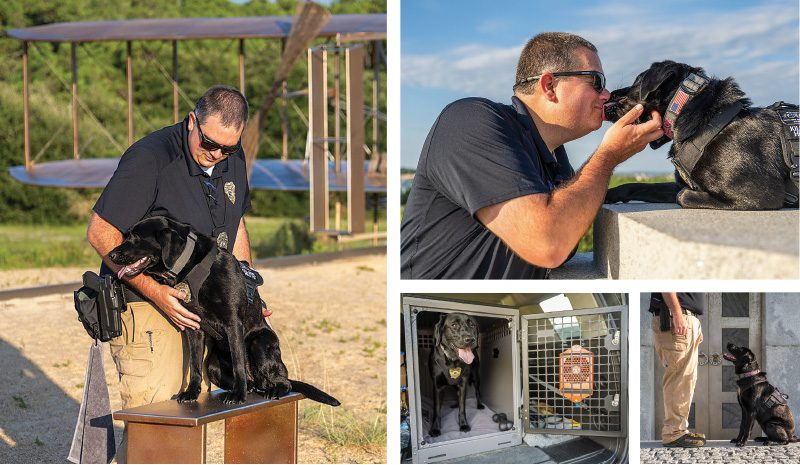
Top left and right: Kill Devil Hills Police Detective Peden with K9 officer, Sailor. While in the field, Sailor performs remarkable feats, in the Peden household she fits right in with the family’s other two dogs.
Bottom: Sailor is one of just nine ESD dogs currently working in North Carolina, the only one in northeastern NC. She’ll often help in other jurisdictions via the State Bureau of Investigation, and she trains every day with Peden in an unending game of hide-and-seek.
“ ‘You mean to tell me there’s a dog that’s going to find a thumb drive?!’ ”
Yep! All of our electronics contain a compound called triphenylphosphine oxide (TPPO), which covers circuit boards to prevent overheating. Sailor, and other ESD K9s like her, have been trained to sniff it out.
Let’s say a bad guy has a cache of photos hidden on a memory card or a portable hard drive: Sailor can walk through the house and tell Peden to check for that hidden compartment in the nightstand or up there in the air duct. Or someone has a burner phone they use for trafficking that they’ve thrown into a field: Sailor can find that—even if it’s been buried! Peden knows of other K9 officers who have discovered thumb drives being used to hide financial fraud under floorboards of houses and finding secret GPS tracking devices in domestic abuse cases. ESD dogs also can help in missing person cases if someone had a phone with them whose battery has since died and can no longer be tracked.
“These dogs are a tool when we already have a legal authority to search. Like a flashlight would light up a dark area, she can help us find stuff that we may not see, or someone may be trying to hide from us,” Peden says. “It’s pretty remarkable to see them work and to see them do what they’re trained to do.”
Peden first heard about ESD dogs while on a training with the National Computer Forensic Institute, which is sponsored by the U.S. Secret Service. Peden worked violent crimes—including five years in homicide—in Charlotte before moving to the Outer Banks in 2021, and while violent crime on the beach is relatively light, he did have to investigate a few cases here that led him to joining the Internet Crimes Against Children Task Force.
More research led him to the Our Rescue organization, which fully funds ESD dogs for law enforcement agencies in the fight to end child exploitation and human trafficking. Our Rescue pays for vet care, medications, food, equipment—even fun baseball-style trading cards that Peden can pass out to kids. The only thing KDH has to cover is travel to the yearly recertification training.
“Without Our Rescue, it wouldn’t be possible for a lot of agencies to have these resources,” Peden says.
Sailor is one of just nine ESD dogs currently working in North Carolina, and she’s the only one in northeastern NC. She’ll often help in other jurisdictions whenever cases come into ICAC through the State Bureau of Investigation, and she trains every day with Peden in an unending game of hide-and-seek.
The work is taxing, with her trainers likening the ESD search effort to the level of running a marathon: “Their heart rate gets up, their breathing gets up looking for that with their nose and deciphering everything,” Peden says. “When we’re working them hard, it’s like 20 to 30 minutes and then they need to rest 20 to 30 minutes.”
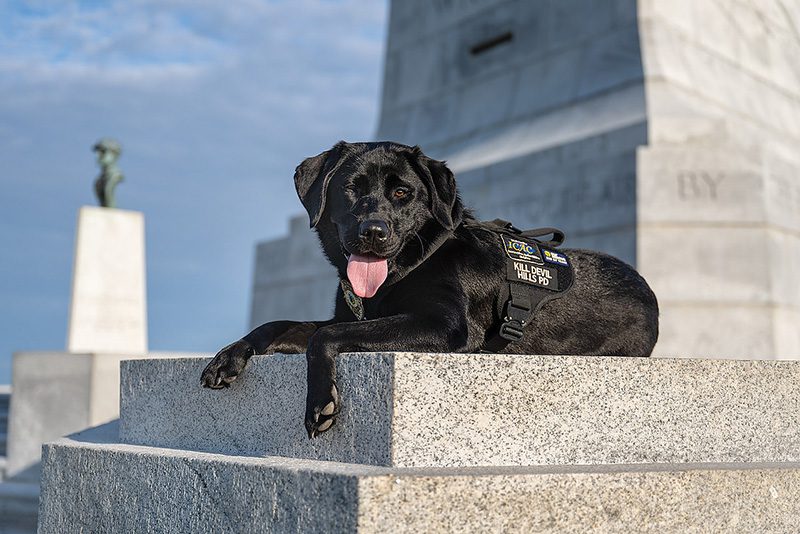
Detective Peden, speaking on Sailor’s friendly demeanor—“She loves to play. She loves kids. She’s just a regular dog, but she doesn’t bark,” Peden says. “I’ve heard her bark six times, and every single one of those times has been because she was unhappy that I wasn’t playing with her still. She lets out one bark and then she’ll immediately go put herself in timeout somewhere and feel ashamed of herself.”
Of course, if there are other dogs around, Sailor doesn’t want anything to do with rest. Peden thinks Sailor may have had to drop out of her original training as a service dog because she loves other dogs too much. At home, Sailor is a natural fit with Peden’s family and their two dogs. She’s best friends with their Golden Retriever and loves stealing multiple socks and carrying them around the house.
“She loves to play. She loves kids. She’s just a regular dog, but she doesn’t bark,” Peden says. “I’ve heard her bark six times, and every single one of those times has been because she was unhappy that I wasn’t playing with her still. She lets out one bark and then she’ll immediately go put herself in timeout somewhere and feel ashamed of herself.”
The cuteness she oozes also comes in handy if the police need to conduct uncomfortable interviews with children about traumatic events – or if an officer is having a rough day. Victim comfort, witness comfort and therapy are big parts of Sailor’s job, as well as being that conversation starter for a problem that is growing more serious every day.
“The education piece is huge. She can bridge a gap between us and kids who may feel we’re not approachable. When you have a Lab flopping around, the kids are more apt to look at her, talk to her,” Peden says. “Our biggest thing is just understanding the digital world we live in. The conversations need to be had about what the children are being exposed to and how they’re being victimized. Her presence alone, they start petting her and everything, she just naturally lifts spirits.”
Steve Hanf is the journalism teacher at First Flight High School. He met Sailor at the Kill Devil Hills Ice Cream Social in September.

Author: Steve Hanf
Steve Hanf is a former professional sportswriter who has taught the journalism classes at First Flight High School since 2015.


